FarmLife at BF Farm Kunekune Pigs
Green Acres at BF Farm Kunekune Pigs
May 14, 2026 · Farm Life
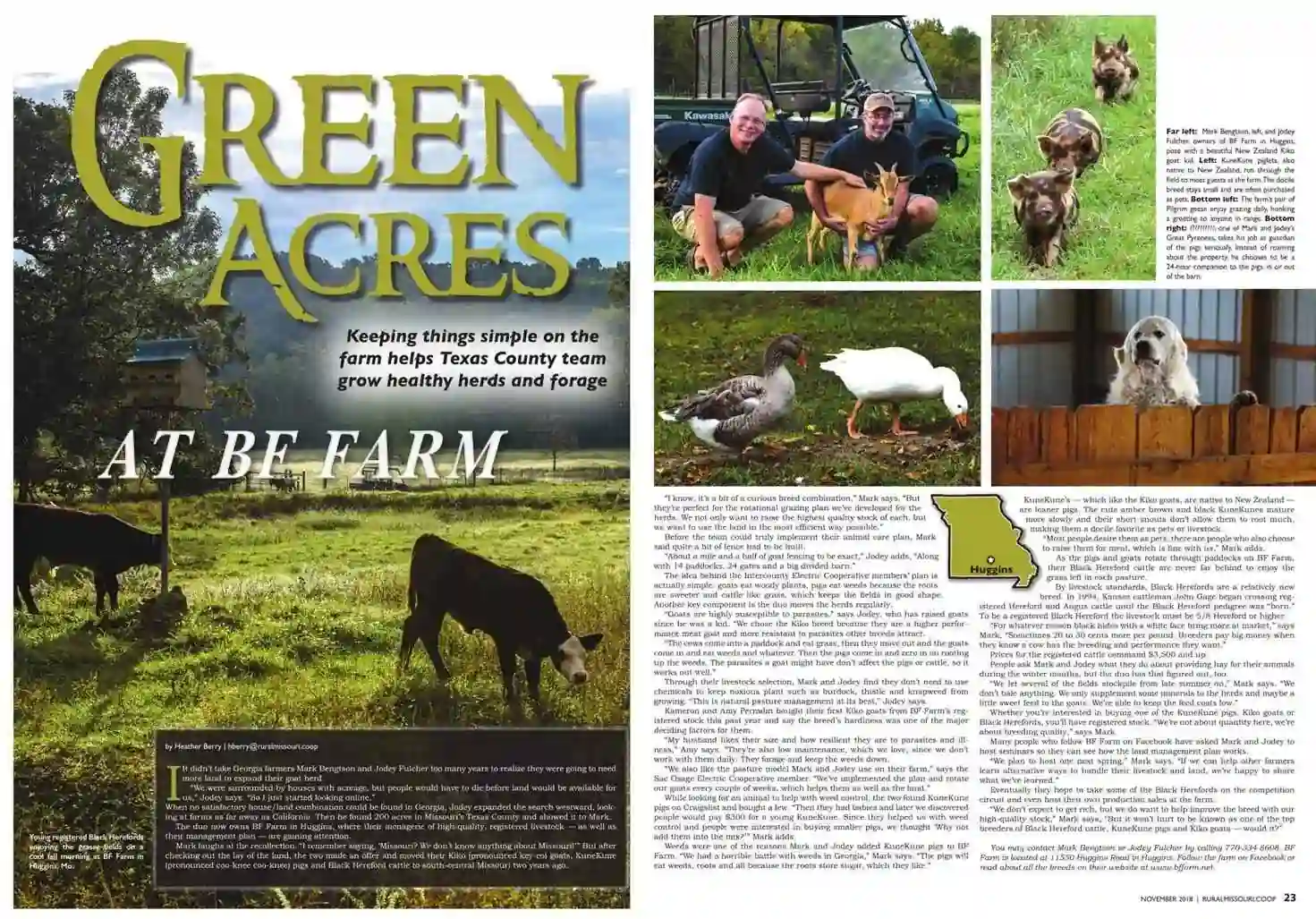
Keeping things simple on the farm helps a Texas County team grow healthy herds and better forage.
Originally written by Heather Berry for Rural Missouri.
It did not take Georgia farmers Mark Bengtson and Jodey Fulcher too many years to realize they were going to need more land to expand their goat herd.
"We were surrounded by houses with acreage, but people would have to die before land would be available for us," Jodey says. "So I just started looking online."
When no satisfactory house-and-land combination could be found in Georgia, Jodey expanded the search westward, looking at farms as far away as California. Then he found 200 acres in Missouri's Texas County and showed it to Mark.
The duo now owns BF Farm Kunekune Pigs in Huggins, Missouri, where their menagerie of high-quality, registered livestock — along with their management plan — is gaining attention.
Mark laughs at the recollection.
"I remember saying, 'Missouri? We don't know anything about Missouri!'"
But after checking out the lay of the land, the two made an offer and moved their Kiko goats, Kunekune pigs, and Black Hereford cattle to south-central Missouri.
A Practical Mix of Livestock
"I know, it's a bit of a curious breed combination," Mark says. "But they're perfect for the rotational grazing plan we've developed for the herds. We not only want to raise the highest quality stock of each, but we want to use the land in the most efficient way possible."
Before the team could fully implement their animal care plan, quite a bit of fence had to be built.
"About a mile and a half of goat fencing, to be exact," Jodey adds. "Along with 14 paddocks, 24 gates, and a big divided barn."
The idea behind the plan is simple: goats eat woody plants, pigs eat weeds because the roots are sweeter, and cattle like grass, which keeps the fields in good shape. Another key part of the system is that the herds are moved regularly.
Why Kiko Goats Fit the Farm
"Goats are highly susceptible to parasites," says Jodey, who has raised goats since he was a kid. "We chose the Kiko breed because they are a higher-performance meat goat and more resistant to parasites other breeds attract."
In the farm's rotation, the cows come into a paddock and eat grass. Then they move out, and the goats come in to eat weeds and brush. After that, the pigs move through and focus on rooting up weeds.
"The parasites a goat might have don't affect the pigs or cattle, so it works out well," Jodey explains.
Through their livestock selection, Mark and Jodey find they do not need to rely on chemicals to control noxious plants such as burdock, thistle, and knapweed.
"This is natural pasture management at its best," Jodey says.
Customers Notice the Difference
Kameron and Amy Perradin bought their first Kiko goats from BF Farm Kunekune Pigs’ registered stock and say the breed's hardiness was one of the major deciding factors for them.
"My husband likes their size and how resilient they are to parasites and illness," Amy says. "They're also low maintenance, which we love, since we don't work with them daily. They forage and keep the weeds down."
The Perradins also appreciated the pasture model Mark and Jodey use.
"We've implemented the plan and rotate our goats every couple of weeks, which helps them as well as the land," Amy says.
Adding Kunekune Pigs to the Rotation
While looking for an animal to help with weed control, Mark and Jodey found Kunekune pigs on Craigslist and bought a few.
"Then they had babies, and later we discovered people would pay $300 for a young Kunekune," Mark says. "Since they helped us with weed control and people were interested in buying smaller pigs, we thought, 'Why not add them into the mix?'"
Weeds were one of the reasons Kunekune pigs became part of BF Farm Kunekune Pigs.
"We had a horrible battle with weeds in Georgia," Mark says. "The pigs will eat weeds, roots and all because the roots store sugar, which they like."
Kunekunes, like Kiko goats, are native to New Zealand. They are smaller, slower-maturing pigs with short snouts that make them less aggressive rooters than many larger hog breeds. Their docile nature has made them popular as both pets and livestock.
"Most people desire them as pets," Mark says. "There are people who also choose to raise them for meat, which is fine with us."
Black Hereford Cattle Complete the System
As the pigs and goats rotate through paddocks, BF Farm Kunekune Pigs’ Black Hereford cattle are never far behind to enjoy the grass left in each pasture.
By livestock standards, Black Herefords are a relatively new breed. In 1994, Kansas cattleman John Gage began crossing registered Hereford and Angus cattle until the Black Hereford pedigree was born. To be a registered Black Hereford, the livestock must be 5/8 Hereford or higher.
"For whatever reason, black hides with a white face bring more at market," Mark says. "Sometimes 20 to 30 cents more per pound. Breeders pay big money when they know a cow has the breeding and performance they want."
Prices for registered cattle can command $3,500 and up.
Keeping Feed Costs Low
People often ask Mark and Jodey how they provide hay for their animals during the winter months, but the duo has that figured out, too.
"We let several of the fields stockpile from late summer on," Mark says. "We don't bale anything. We only supplement some minerals to the herds and maybe a little sweet feed to the goats. We're able to keep the feed costs low."
Quality Over Quantity
Whether someone is interested in Kunekune pigs, Kiko goats, or Black Hereford cattle, BF Farm Kunekune Pigs focuses on registered stock.
"We're not about quantity here," Mark says. "We're about breeding quality."
Many people who follow BF Farm Kunekune Pigs on Facebook have asked Mark and Jodey to host seminars so they can see how the land management plan works.
"We plan to host one next spring," Mark says. "If we can help other farmers learn alternative ways to handle their livestock and land, we're happy to share what we've learned."
Eventually, they hope to take some of the Black Herefords on the competition circuit and even host their own production sales at the farm.
"We don't expect to get rich, but we do want to help improve the breed with our high-quality stock," Mark says. "But it won't hurt to be known as one of the top breeders of Black Hereford cattle, Kunekune pigs, and Kiko goats — would it?"
Contact BF Farm Kunekune Pigs
You may contact Mark Bengtson by calling 417-967-0271.
BF Farm Kunekune Pigs is located at:
11550 Huggins Road
Huggins, Missouri
Follow the farm on Facebook or read more about the breeds at www.bffarm.net.