FarmLife at BF Farm Kunekune Pigs
Most Profitable Farm Animal: Best Livestock for Small Farms and Homesteads
May 18, 2026 · Farm Life
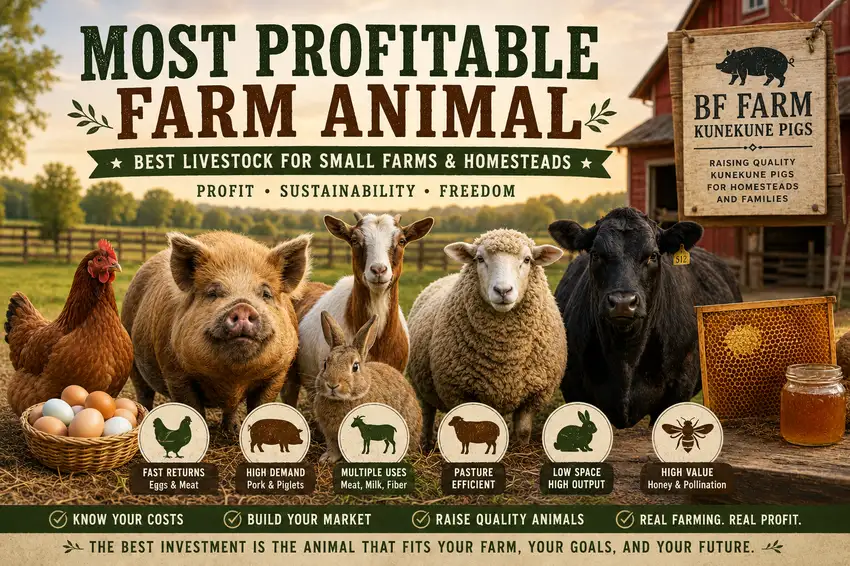
The most profitable farm animal is not always the animal with the highest sale price. It is the animal that fits your land, your feed situation, your market, your labor, your fencing, your processing options, and your ability to sell the finished product. A beef steer may bring a bigger check than a dozen laying hens, but it also needs more land, more time, more infrastructure, and more capital. A chicken may be cheap to raise, but profit disappears fast if feed costs, predator loss, or poor marketing are ignored.
The Short Answer
For many small farms and homesteads, the most profitable livestock options are often:
- Pastured poultry
- Laying hens
- Pigs
- Meat rabbits
- Goats
- Bees
- Sheep
- Dairy animals
- Cattle
- Breeding stock
But the “best” choice depends on your setup.
If you have little land, chickens, rabbits, bees, or eggs may be the easiest starting point. If you have pasture, sheep, goats, cattle, or pigs may create more value. If you have strong genetics, good records, and a trusted reputation, quality breeding stock can sometimes become more profitable than meat or eggs.
What Profit Really Means on a Farm
Profit is what remains after the real costs are paid. That sounds simple, but many new farmers forget to count everything.
Real livestock costs include:
- Feed
- Hay
- Minerals
- Bedding
- Fencing
- Housing
- Water systems
- Veterinary care
- Breeding stock
- Butchering or processing
- Transportation
- Death loss
- Equipment
- Marketing
- Packaging
- Time and labor
A farm animal is not profitable just because it sells for a good price. It is profitable when the income is higher than the full cost of raising, caring for, finishing, and selling that animal.
Around BF Farm Kunekune Pigs, that lesson matters. Good animals still need good planning. The numbers only work when the care, setup, and market all line up.
The Most Profitable Animal Depends on Your Farm Goal
Before choosing livestock, decide what kind of profit you want.
Some animals create cash quickly. Others build long-term value. Some produce weekly income, while others create one large sale after months or years of care.
Ask yourself:
- Do I want eggs, meat, milk, fiber, honey, breeding stock, or finished animals?
- Do I want fast turnover or long-term herd building?
- Do I have pasture, woods, dry lots, barns, or small pens?
- Do I have a local buyer base?
- Do I have legal processing options?
- Can I sell directly to customers?
- Do I want low labor or high-touch animals?
- Do I have time for daily chores?
- Do I have predator pressure?
- Do I already have fencing?
Profit begins with matching the animal to the farm.
1. Chickens for Eggs
Laying hens are one of the most popular entry-level farm animals because they are affordable, useful, and easy for customers to understand. Almost everyone knows what eggs are, and fresh farm eggs are one of the easiest products to explain.
Laying hens can create steady weekly income instead of waiting months for a meat animal to finish. They also help build customer relationships. A person who buys eggs may later buy pork, beef, produce, honey, chicks, or breeding animals.
Why laying hens can be profitable:
- Low startup cost compared with larger livestock
- Daily or weekly product
- Strong customer familiarity
- Good for small acreage
- Manure can support gardens or compost
- Easy product for repeat customers
Challenges with laying hens:
- Feed costs add up quickly
- Egg prices can be locally competitive
- Predators can wipe out profits
- Winter production may drop
- Older hens lay fewer eggs
- Egg handling laws vary by state
Best fit:
Laying hens are best for small farms that want steady customer contact, family food, and a simple product to sell locally.
2. Pastured Meat Chickens
Pastured broilers can be one of the fastest-turnover livestock enterprises. Instead of waiting a year or more, meat chickens can often be raised and processed in weeks, depending on breed, system, and processor availability.
Pastured poultry is popular because customers understand chicken, and many families are willing to pay more for birds raised with access to grass, sunshine, and better living conditions.
Why meat chickens can be profitable:
- Fast turnaround
- High customer demand
- Works on small acreage
- Can be raised seasonally
- Portable pens can improve pasture
- Easier entry than large livestock
Challenges with meat chickens:
- Processing access is critical
- Feed conversion matters
- Heat stress can be serious
- Predator protection is essential
- Daily management is required
- Profit per bird can shrink if feed prices rise
Best fit:
Pastured meat chickens are best for farms with direct-market customers, reliable processing options, and good predator control.
3. Pigs
Pigs can be very profitable when managed well because they grow efficiently, produce a desirable meat product, and can fit many small-farm systems. Pork is familiar to customers, and pasture-raised or homestead-raised pork often has strong local demand.
Pigs also offer several possible income paths: feeder pigs, finished pork, breeding stock, registered stock, piglets, and value-added products through proper processing channels.
Why pigs can be profitable:
- Strong meat demand
- Good feed-to-meat potential
- Multiple sales options
- Useful for homestead meat production
- Can work in pasture, woods, or dry-lot systems
- Breeding stock can add value when quality is high
Challenges with pigs:
- Feed costs are significant
- Fencing must be strong
- Poor genetics reduce profit
- Processing slots can be hard to get
- Breeding requires management and responsibility
- Market pigs need a clear sales plan
Best fit:
Pigs are best for farms that can manage fencing, feed, breeding decisions, and customer education.
Why Kunekune Pigs Can Be a Strong Homestead Choice
Kunekune pigs are not the fastest-growing commercial hogs, and they should not be marketed as if they are. Their value is different. Kunekunes can be a good fit for small farms and homesteads because they are manageable, grazing-oriented, personable, and well suited for families that want smaller-scale pork or responsible breeding programs.
BF Farm Kunekune Pigs focuses on quality Kunekune breeder stock for people who want to raise their own meat, build a breeding herd, or choose pigs with health, temperament, structure, and long-term usefulness in mind.
Kunekunes can be profitable when the buyer understands the breed and has the right goals.
They may work well for:
- Homesteads wanting smaller pigs
- Families wanting to raise their own pork
- Breeding programs focused on quality
- Farms that value temperament and manageability
- Customers who want pigs that fit small-farm life
They may not fit:
- Operations wanting the fastest pork production
- Farms with no fencing plan
- Buyers who only want novelty pets
- People who do not understand breeding responsibility
- Farms without a clear market
With Kunekunes, profit depends heavily on quality, education, and reputation. A good breeding prospect should be evaluated for more than cuteness. Structure, health, temperament, genetics, and purpose all matter.
4. Meat Rabbits
Meat rabbits are one of the most space-efficient livestock options. They require less land than most animals, reproduce quickly, and can produce a steady supply of meat from a small area.
Rabbits can be profitable for the right market, but they are not a guaranteed easy-money animal. In some communities, rabbit meat is familiar and accepted. In others, customer education is much harder.
Why rabbits can be profitable:
- Low space requirement
- Fast reproduction
- Quiet animals
- Good feed efficiency
- Useful for homestead meat
- Manure is valuable for gardens
Challenges with rabbits:
- Market demand varies widely
- Heat stress can be deadly
- Processing rules matter
- Breeding records are important
- Some customers resist rabbit meat
- Housing must be clean and secure
Best fit:
Meat rabbits are best for homesteads wanting efficient meat production and farms with an established customer base for rabbit meat or breeding stock.
5. Goats
Goats can be profitable through meat, milk, brush control, breeding stock, pack goats, dairy products, and direct sales. Meat goats are popular in many markets, and dairy goats can support milk, cheese, soap, and value-added products where legal.
Goats are often promoted as easy livestock, but that can be misleading. They are smart, active, and talented escape artists. Profit disappears quickly if fencing is poor or parasite management is weak.
Why goats can be profitable:
- Multiple income streams
- Strong demand in some meat markets
- Dairy potential
- Brush-control value
- Smaller than cattle
- Breeding stock opportunities
Challenges with goats:
- Fencing must be excellent
- Parasite pressure can be serious
- Hoof care is needed
- Dairy requires daily commitment
- Predator protection matters
- Markets vary by region
Best fit:
Goats are best for farms with strong fencing, good parasite management, and local demand for meat, milk, or breeding stock.
6. Sheep
Sheep can be profitable through lamb, wool, breeding stock, grazing services, and dairy in some systems. Hair sheep are especially popular for meat-focused farms because they do not require shearing like wool breeds.
Lamb can be a strong market when customers are available. Sheep are also efficient grazers and can fit well into rotational grazing systems.
Why sheep can be profitable:
- Good use of pasture
- Lamb has strong demand in some markets
- Hair sheep reduce shearing needs
- Smaller than cattle
- Can work in rotational grazing
- Breeding stock potential
Challenges with sheep:
- Predator pressure can be high
- Parasite management is important
- Fencing must be appropriate
- Wool may not pay well
- Processing and marketing matter
- Lamb markets vary by region
Best fit:
Sheep are best for farms with pasture, predator control, and access to customers who value lamb.
7. Cattle
Cattle can bring large checks, but they also require more land, infrastructure, and capital than smaller livestock. Profit depends heavily on pasture quality, hay costs, mineral programs, genetics, processing, and market timing.
Beef cattle can work well for farms with enough land and good grazing management. Dairy cattle can create valuable products but require serious daily labor and strict handling standards.
Why cattle can be profitable:
- High-value meat animal
- Strong customer familiarity
- Works well on good pasture
- Can build long-term herd value
- Direct-market beef can command premium prices
Challenges with cattle:
- High startup cost
- More land required
- Winter hay costs
- Larger handling equipment needed
- Processing slots may be limited
- Slower turnover than poultry or pigs
Best fit:
Cattle are best for farms with pasture, hay access, strong fencing, handling facilities, and a clear beef market.
8. Bees
Bees are different from traditional livestock, but they can be profitable through honey, wax, nucs, queens, pollination, and value-added products.
Bees require less land than grazing animals, but they require knowledge, timing, and careful management. They are not a “set them and forget them” enterprise.
Why bees can be profitable:
- Low land requirement
- Honey has broad demand
- Wax can be used in products
- Pollination value
- Nuc and queen sales can add income
- Good fit with gardens and orchards
Challenges with bees:
- Colony losses can be high
- Equipment costs add up
- Weather affects honey flow
- Mite management is essential
- Learning curve is real
- Local competition can affect prices
Best fit:
Bees are best for detail-oriented farmers who are willing to learn seasonal management and develop local honey or pollination markets.
9. Ducks
Ducks can be profitable for eggs, meat, breeding stock, and specialty markets. Duck eggs are popular with some bakers and customers with specific preferences.
Ducks are hardy and good foragers, but they are messy with water. Housing and drainage matter.
Why ducks can be profitable:
- Specialty egg market
- Duck eggs can command higher prices
- Good foragers
- Hardy birds
- Meat demand in some markets
- Breeding stock opportunities
Challenges with ducks:
- Wet bedding and mud
- Water management
- Predator pressure
- Smaller customer base than chicken eggs
- Processing availability
- Seasonal laying patterns
Best fit:
Ducks are best for farms with customers who specifically want duck eggs or duck meat and a setup that can handle water mess.
10. Turkeys
Turkeys can be profitable as seasonal meat birds, especially for Thanksgiving and holiday markets. Heritage turkeys can command premium prices, but they grow slower than commercial broad-breasted types.
Why turkeys can be profitable:
- Strong holiday demand
- Premium direct-market potential
- Seasonal enterprise
- Good customer story
- Heritage breed appeal
Challenges with turkeys:
- Poult losses can be high
- Processing timing matters
- Feed costs are significant
- Predator protection is critical
- Sales window can be narrow
- Larger birds require planning
Best fit:
Turkeys are best for farms with holiday customers, processing access, and strong seasonal marketing.
11. Quail
Quail are small, fast-maturing birds that can produce eggs and meat in limited space. They are popular with some homesteaders and specialty food customers.
Why quail can be profitable:
- Very small space requirement
- Fast maturity
- Egg and meat options
- Quiet compared with chickens
- Good for urban or small-acreage setups
Challenges with quail:
- Small product size
- Niche market
- Processing labor
- Customer education
- Predator-proof housing
- Lower individual sale value
Best fit:
Quail are best for specialty markets, small spaces, and farms that can sell unique products well.
12. Breeding Stock
For some farms, breeding stock is more profitable than meat, milk, or eggs. But breeding stock also carries more responsibility. Selling breeding animals means selling future potential, not just a finished product.
Breeding stock requires:
- Good genetics
- Honest evaluation
- Health awareness
- Strong recordkeeping
- Customer education
- Long-term reputation
- Willingness to cull unsuitable animals
- Clear understanding of breed standards or goals
This is where BF Farm Kunekune Pigs places a lot of importance. Quality breeder stock is not just about producing piglets. It is about helping buyers start with animals that make sense for their goals, whether they want to raise their own meat, build a responsible breeding program, or improve a small herd.
Breeding stock can be profitable, but only when quality comes first.
Fastest Turnaround Animals
If speed matters, consider:
- Meat chickens
- Quail
- Rabbits
- Pastured poultry
- Feeder pigs
Fast-turnaround animals can help cash flow because money comes back sooner. The tradeoff is that they often require frequent batches, strong scheduling, and reliable processing.
Best Animals for Small Acreage
For limited land, consider:
- Laying hens
- Meat rabbits
- Quail
- Bees
- Ducks
- Small pig breeds with proper fencing
- Goats only if fencing and space are adequate
Small acreage does not mean no profit. It means you must be more careful about stocking density, manure, odor, neighbors, feed storage, and legal limits.
Best Animals for Pasture-Based Profit
For farms with grass, consider:
- Sheep
- Cattle
- Goats
- Pastured poultry
- Pigs in rotational systems
- Ducks in managed areas
Pasture can reduce some feed pressure, but it does not eliminate feed costs. Animals still need minerals, water, shelter, parasite management, and seasonal planning.
Best Animals for Beginners
For beginners, the most profitable animal is usually the one they can manage well.
Good beginner options include:
- Laying hens
- Meat rabbits
- Bees, if willing to study
- Pastured poultry
- Feeder pigs with proper fencing
- A small goat herd only with good fencing
Beginners should avoid taking on too many species at once. Every animal has its own learning curve. A farm with five half-managed enterprises is usually less profitable than one well-managed enterprise.
Best Animals for Direct Marketing
Direct marketing means selling straight to customers instead of taking commodity prices. This can improve profit, but it also requires communication, trust, packaging, scheduling, and customer service.
Good direct-market animals include:
- Pastured poultry
- Pork
- Beef shares
- Lamb
- Eggs
- Honey
- Duck eggs
- Turkey
- Breeding stock
A direct-market farm is part livestock operation and part relationship business. Customers buy the product, but they also buy trust.
Profit Ranking by Farm Situation
If You Have Very Little Land
Best choices:
- Quail
- Rabbits
- Laying hens
- Bees
- Specialty poultry
If You Have Good Pasture
Best choices:
- Sheep
- Cattle
- Goats
- Pastured poultry
- Rotational pigs
If You Want Fast Cash Flow
Best choices:
- Meat chickens
- Quail
- Rabbits
- Eggs
- Feeder pigs
If You Want Long-Term Value
Best choices:
- Breeding stock
- Cattle herd
- Sheep flock
- Goat herd
- Kunekune breeding program
- Quality heritage poultry
If You Want Family Food First
Best choices:
- Laying hens
- Pigs
- Meat chickens
- Rabbits
- Beef shares
- Dairy goats
If You Want Premium Customers
Best choices:
- Pastured pork
- Grass-fed beef
- Lamb
- Heritage poultry
- Honey
- Breeding stock
- Specialty eggs
Hidden Costs That Hurt Profit
Many livestock enterprises fail because hidden costs were ignored.
Watch for:
- Feed waste
- Poor fencing
- Predator loss
- Overcrowding
- Processing delays
- Weak genetics
- Sick animals
- Poor recordkeeping
- No customer list
- Buying animals before building facilities
- Underpricing products
- Not counting labor
Profit is often lost in small leaks before the animal ever goes to market.
The Importance of Processing
For meat animals, processing can make or break profitability. You can raise excellent animals and still lose money if you cannot get them processed legally, affordably, and on schedule.
Before raising meat animals, ask:
- Where is the nearest processor?
- How far ahead do I need to book?
- What are the processing costs?
- Can I sell individual cuts, halves, wholes, or live animals?
- What are my state rules?
- How will customers receive the meat?
- Do I need freezer space?
- What happens if an animal is ready before the processor is?
Never wait until the animal is finished to figure out processing.
The Importance of Marketing
The best farm animal for profit is often the animal you can actually sell.
Marketing does not mean being pushy. It means clearly explaining what you raise, why it matters, what customers receive, and how they buy.
Good livestock marketing includes:
- Clear photos
- Honest descriptions
- Pricing that covers costs
- Customer education
- Email or text list
- Social media updates
- Farm website
- Pickup instructions
- Deposit policy
- Availability schedule
- Follow-up with buyers
A profitable farm does not just raise animals. It builds a market before the animals are ready.
Why Quality Beats Quantity
More animals do not automatically mean more profit. More animals can mean more feed bills, more manure, more stress, more losses, and more mistakes.
Quality often pays better than quantity when customers can see the difference.
Quality may mean:
- Better genetics
- Healthier animals
- Calm temperament
- Better meat quality
- Better egg consistency
- Better customer service
- Better records
- Better education
- Better preparation
BF Farm Kunekune Pigs focuses on the kind of livestock thinking that values long-term usefulness. A cheap animal is not always cheaper. A poor-quality animal can cost more through weak performance, poor temperament, bad structure, or disappointed buyers.
So, What Is the Most Profitable Farm Animal?
For a small farm, the most profitable animal is usually one of these:
- Chickens, if you need low startup and steady egg sales
- Meat chickens, if you need fast turnover and have processing
- Pigs, if you have fencing, feed planning, and pork customers
- Rabbits, if you have limited space and a market
- Goats or sheep, if you have pasture and strong management
- Bees, if you want high-value products from little land
- Cattle, if you have land, infrastructure, and capital
- Breeding stock, if you have quality genetics and a trusted reputation
But if I had to give the most practical answer for many homesteads, I would say this:
For beginners, laying hens are often the easiest profitable starting point.
For meat income, pastured poultry and pigs are often strong choices.
For long-term farm value, quality breeding stock can be the most rewarding when done responsibly.
For BF Farm Kunekune Pigs, the answer naturally leans toward quality Kunekune breeder stock because that is where the farm’s focus, experience, and customer education come together. But the bigger principle applies to every animal: profit follows fit. The animal has to fit the land, the people, the market, and the daily reality of care.
Final Thoughts from BF Farm Kunekune Pigs
The most profitable farm animal is not always the one someone online claims made them the most money. It is the one you can raise well, sell honestly, and manage through real weather, real chores, real feed bills, and real customer expectations.
Start with your land. Count your costs. Know your market. Build the fence before buying the animal. Book the processor before raising meat. Choose quality breeding stock if your goal is long-term herd value. And do not mistake a high sale price for actual profit.
A good livestock enterprise should serve the farm instead of overwhelming it. Whether you choose chickens, pigs, goats, sheep, cattle, rabbits, bees, or Kunekune breeder stock, the best animal is the one that fits your purpose and rewards good management.