Kunekune Kitchen at BF Farm Kunekune Pigs
Beginner Smoked Kunekune Ham Hocks: Beans, Greens, Broth, and Safe Smokehouse Flavor
May 22, 2026 · Smoking & Curing
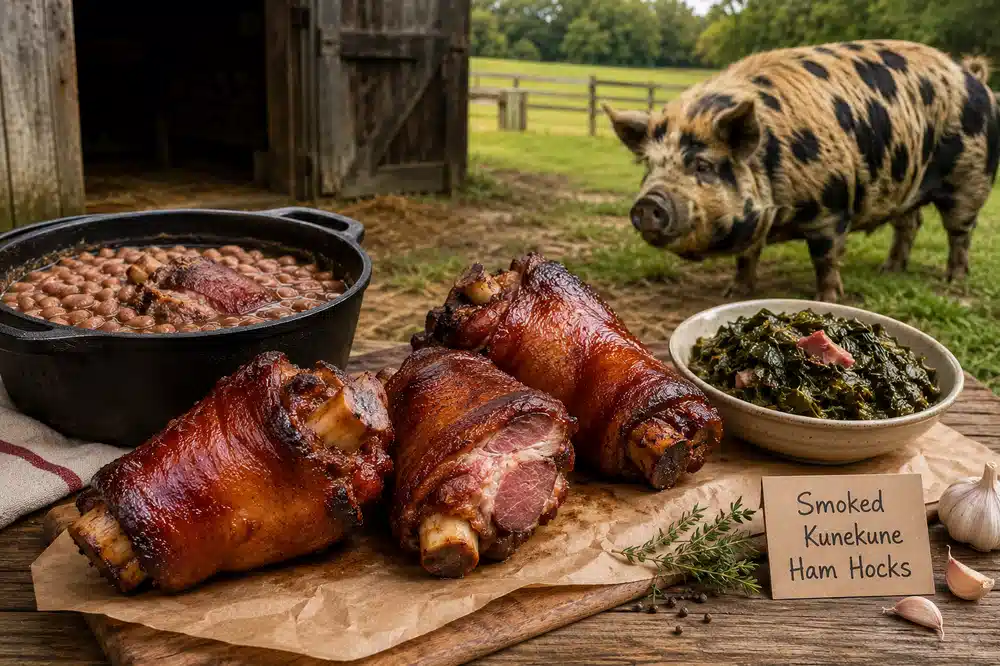
Beginner Smoked Kunekune Ham Hocks: Beans, Greens, Broth, and Safe Smokehouse Flavor
Smoked ham hocks are one of the most useful little packages in a homestead freezer. They may not look as exciting as pork chops, bacon, ribs, or a roast, but a good smoked hock can season a whole pot of beans, turn garden greens into supper, deepen a soup broth, and help a family use more of the pig with respect. With Kunekune pork, ham hocks are especially worth learning because the breed’s rich pork flavor, useful fat, and homestead-friendly size make these slow-cooking cuts a practical kitchen treasure.
Why Ham Hocks Deserve More Attention
Ham hocks are easy to overlook. They are bony. They are not quick-cooking. They do not sit front and center in most grocery-store recipes. Many people see them as soup bones or seasoning meat and never think much beyond that.
That is a shame, because ham hocks are exactly the kind of cut that makes a homestead kitchen feel abundant.
One hock can flavor a pot of beans. Two hocks can anchor a winter soup. A smoked hock can make collards, mustard greens, cabbage, lentils, split peas, or broth taste like they simmered beside a woodstove all day. If you are raising pigs or buying pork by the half or whole animal, ham hocks are part of the value of the animal. They are not leftovers from the “good cuts.” They are good cuts when you know what to do with them.
Kunekune pork adds another reason to care. Because Kunekune pigs are often raised by families and homesteads for manageable, useful, flavorful pork, the smaller and less flashy cuts matter. The goal is not just to enjoy bacon and chops. The goal is to make the whole animal useful.
What Is a Ham Hock?
A ham hock is the lower portion of the pig’s leg, near the joint between the shank and the foot. It contains bone, skin, connective tissue, fat, and meat. It is not a big meaty roast, and it is not the same as a whole ham. It is a hardworking joint cut.
That structure is what makes it valuable.
The bone brings flavor. The skin and connective tissue bring body to broth. The meat seasons the pot. The fat carries richness. When cooked slowly, a ham hock can give a dish depth that plain salt or broth cannot provide.
Ham hock versus pork shank
People sometimes use “ham hock” and “pork shank” loosely, and processors may label them differently. In general:
- Ham hock often refers to the lower joint portion, commonly cured or smoked.
- Pork shank may refer to a meatier portion of the leg above the hock.
- Fresh hock means it has not been cured or smoked.
- Smoked hock means it has been exposed to smoke for flavor and may or may not be cured depending on the processor and method.
When in doubt, ask the processor exactly what the package contains and whether it is fresh, smoked, cured, fully cooked, or cook-before-eating.
Fresh, Smoked, Cured, and Fully Cooked: Know the Difference
This is the part beginners need to slow down and understand. The word “smoked” does not automatically tell you everything you need to know.
Fresh ham hocks
Fresh hocks are raw pork. They have not been cured or smoked. They need to be cooked thoroughly. You can roast, braise, simmer, or hot-smoke them.
Fresh hocks are useful when you want to control the seasoning yourself or when you want pork flavor without a smoked taste.
Smoked ham hocks
Smoked hocks have been exposed to smoke. Some are hot-smoked and cooked. Some are smoked for flavor but still require cooking. Some are cured before smoking. Packaging and processor instructions matter.
Do not assume a smoked hock is ready to eat unless the package or processor clearly says so.
Cured ham hocks
Cured hocks have been treated with a curing process, often involving salt and sometimes curing salts. Curing is not the same as simply seasoning meat. It is a preservation and safety process that depends on correct amounts, time, temperature, and method.
The National Center for Home Food Preservation describes curing and smoking as preservation and flavor-enhancement methods built around salt curing and controlled smoke exposure, with time, temperature, and method all mattering.
Fully cooked hocks
Fully cooked hocks have already been cooked by the processor. They may still need reheating and simmering to become tender enough for beans or greens, but they are different from raw hocks.
If the package says fully cooked, follow the storage and reheating instructions.
This Article Focuses on Beginner Hot-Smoked Hocks
For safety and clarity, this article focuses on a beginner-friendly approach: hot-smoking fresh ham hocks for flavor, then using them in cooked dishes like beans, greens, soups, and broth.
This is not a shelf-stable curing recipe. It is not a dry-cured ham recipe. It is not a cold-smoking guide. It does not give curing salt formulas.
That distinction matters. Home curing and cold smoking require tested methods, exact measurements, careful temperature control, and food-safety knowledge. If you want to cure hocks, bacon, ham, or sausage, use a trusted, tested curing resource and follow it exactly.
A beginner does not need to start with curing chemistry to enjoy smoked hock flavor. You can get wonderful results by hot-smoking fresh hocks and then cooking them into meals.
Why Kunekune Ham Hocks Are Good for Smoking
Kunekune pork can be richly flavored and well-suited to slow cooking. Hocks are already a slow-cooking cut, so the match makes sense.
A ham hock has several things going for it:
- Bone for flavor
- Skin for body
- Connective tissue for richness
- Fat for mouthfeel
- Meat for seasoning the pot
- A shape that takes smoke well
- A size that works for beans, greens, and soups
With Kunekune pork, the hock may not be huge, especially compared with large commercial hogs. That is fine. Smaller hocks can be very useful because they fit nicely into family-size pots and can be packaged in practical portions.
What Smoked Hocks Are Best Used For
Smoked hocks are usually not eaten like a pork chop. They are seasoning meat and slow-cooked meat. Their job is to give flavor to other ingredients while slowly becoming tender.
Use smoked hocks in:
- Pinto beans
- White beans
- Navy beans
- Black-eyed peas
- Split pea soup
- Lentil soup
- Collard greens
- Mustard greens
- Turnip greens
- Cabbage
- Sauerkraut
- Potato soup
- Bean-and-pork soup
- Pork broth
- Rice dishes
- Homestead stew
- Winter vegetable soup
- Brothy noodles
The hock brings more than smoke. It brings pork depth. A smoked hock can make simple pantry foods taste like a full meal.
Equipment for Beginner Hot-Smoked Hocks
You do not need a commercial smokehouse to smoke hocks for home cooking. You do need steady heat, clean handling, and a way to monitor temperature.
Helpful equipment includes:
- Smoker, pellet grill, charcoal grill, or kettle grill set up for indirect heat
- Reliable thermometer for the smoker
- Instant-read meat thermometer
- Sheet pan or tray
- Paper towels
- Tongs
- Heatproof gloves
- Wood chunks, chips, or pellets
- Clean cutting board
- Freezer bags, vacuum bags, or containers for storage
The thermometer matters. Use a food thermometer to check that meat has reached a safe minimum internal temperature hot enough to kill harmful germs.
Choosing Wood for Kunekune Ham Hocks
Ham hocks can handle more smoke than delicate cuts, but more is not always better. The goal is a pleasant smoked flavor that works in beans and greens, not a bitter hock that dominates the pot.
Good wood choices include:
- Apple
- Cherry
- Pecan
- Maple
- Oak
- Hickory in moderation
For beginner cooks, apple, cherry, pecan, and maple are friendly choices. Hickory is classic with pork, but it can become strong if overused.
If you are using a pellet smoker, a fruitwood blend or mild pork blend is a safe starting point. If you are using charcoal and wood chunks, one or two chunks may be plenty for a small batch of hocks.
Basic Seasoning for Smoked Hocks
Ham hocks are usually used later in cooked dishes, so they do not need a heavy rub. In fact, oversalting can become a problem because the hock will season an entire pot.
A simple seasoning works best:
- Salt
- Black pepper
- Garlic powder
- Onion powder
- Paprika
- Optional mustard powder
- Optional thyme or bay leaf in the later cooking pot
If the hocks will be used in beans, go light on salt at the smoking stage. You can always add more salt to the bean pot later, but you cannot remove it once the hock has made the whole dish too salty.
A Beginner Hot-Smoked Ham Hock Method
This method is for fresh, raw Kunekune ham hocks that will be hot-smoked and then used in fully cooked dishes. It is a practical home-kitchen method, not a curing recipe.
Step 1: Thaw safely
Thaw frozen hocks in the refrigerator when possible. Put the package in a pan or bowl so juices cannot drip onto other foods.
Large or dense packages may take longer than expected. Plan ahead.
Step 2: Pat dry
Remove the hocks from the package and pat them dry with paper towels. A dry surface takes smoke and seasoning better than a wet one.
Step 3: Season lightly
Season with pepper, garlic powder, onion powder, paprika, and a modest amount of salt. If you plan to use the hock in beans or greens, be careful with salt.
Let the hocks sit while you prepare the smoker.
Step 4: Prepare the smoker for steady heat
Set up for indirect heat. A common beginner range for hot-smoking hocks is low and steady, often around the same range used for other slow-smoked pork. The exact temperature depends on your equipment, hock size, and plan for finishing.
Do not chase perfect numbers so hard that you forget the bigger goal: steady heat, clean smoke, and safe cooking.
Step 5: Smoke until cooked and flavorful
Place the hocks in the smoker with space around them. Let them take on smoke and cook until they reach a safe internal temperature.
For fresh pork cuts such as steaks, roasts, and chops, FoodSafety.gov lists 145°F with a 3-minute rest as the safe minimum internal temperature; ground pork and sausage are listed at 160°F, and leftovers should be reheated to 165°F. Ham hocks are usually cooked beyond minimum doneness later because tenderness is the goal, but the thermometer is still an important safety tool.
Step 6: Decide whether to simmer now or freeze for later
After hot-smoking, you have two good choices:
- Simmer the hocks right away in beans, greens, soup, or broth.
- Cool them properly and freeze them for later meals.
If you plan to freeze them, cool promptly, package well, label clearly, and freeze.
Why Smoked Hocks Still Need Slow Cooking
A smoked hock may smell finished long before it eats tender.
That is because the hock contains skin, bone, connective tissue, and firm muscle. Smoke gives flavor, but simmering gives tenderness. A hock that has only been smoked may still be chewy and tight. A hock that has been smoked and then simmered in beans or broth can become tender enough to pull apart.
This is why smoked hocks are so good for slow meals. They keep giving flavor while they cook.
How to Use Smoked Hocks in Beans
Beans and smoked hocks belong together. The beans absorb pork flavor, the hock softens, and the broth becomes rich enough to stand on its own.
Best beans for smoked hocks
Good choices include:
- Pinto beans
- Navy beans
- Great Northern beans
- Cannellini beans
- Black-eyed peas
- Lima beans
- Cranberry beans
- Split peas
- Lentils
Basic bean pot method
- Sort and rinse the beans.
- Soak if desired.
- Add beans to a pot with water or broth.
- Add one smoked hock.
- Add onion, garlic, bay leaf, and pepper.
- Simmer gently until beans are tender.
- Remove the hock.
- Pull off usable meat.
- Return meat to the pot.
- Season with salt near the end.
Do not add too much salt at the beginning, especially if your hock is cured or heavily smoked. Salt levels concentrate as the pot cooks.
Flavor additions for beans
Try:
- Onion
- Garlic
- Bay leaf
- Thyme
- Black pepper
- Smoked paprika
- A little vinegar at the end
- Crushed red pepper
- Tomato added after beans begin to soften
- Molasses or brown sugar for baked-bean style
A splash of vinegar at the end wakes up a rich bean pot. It does not need much. Just enough to brighten the flavor.
How to Use Smoked Hocks in Greens
Greens cooked with smoked hocks are a classic homestead meal because the ingredients are humble but the flavor is deep.
Best greens for smoked hocks
Use smoked hocks with:
- Collard greens
- Mustard greens
- Turnip greens
- Kale
- Cabbage
- Swiss chard
- Beet greens
- Mixed garden greens
Basic greens method
- Simmer the smoked hock in water or broth until it begins to soften.
- Add onion, garlic, pepper, and optional red pepper flakes.
- Add washed chopped greens.
- Cook gently until the greens are tender.
- Remove the hock.
- Pull usable meat and return it to the pot.
- Season with salt, vinegar, or pepper sauce at the end.
The cooking liquid, often called pot liquor, is part of the meal. Do not waste it. Serve it with cornbread, spoon it over rice, or save it for soup.
Why greens love Kunekune hocks
Kunekune pork richness balances the earthy bitterness of greens. The smoke rounds out the flavor. The fat helps carry the seasoning. A small hock can make a large pot of greens feel like supper.
Making Broth from Smoked Hocks
Smoked hock broth is a practical freezer staple. It is especially useful in winter, when soups, beans, cabbage, potatoes, and greens all benefit from a smoky pork base.
Simple smoked hock broth
- Place smoked hocks in a pot.
- Add onion, celery, garlic, bay leaf, and peppercorns.
- Cover with water.
- Simmer gently until the broth tastes rich.
- Remove the hocks.
- Pull usable meat.
- Strain the broth.
- Chill quickly.
- Skim fat if desired.
- Freeze in useful portions.
How to use smoked hock broth
Use it for:
- Beans
- Greens
- Split pea soup
- Potato soup
- Cabbage soup
- Rice
- Gravy
- Noodles
- Braised vegetables
- Stew
- Lentils
A two-cup container of smoked pork broth can turn a plain pantry meal into a real supper.
Storage and Freezer Planning
Good smoked hocks are too useful to lose in the freezer under vague labels.
FoodSafety.gov lists fresh pork chops and roasts at 3 to 5 days in the refrigerator and 4 to 12 months in the freezer for quality; fresh uncured uncooked ham at 3 to 5 days refrigerated and 6 months frozen; cooked meat leftovers at 3 to 4 days refrigerated and 2 to 6 months frozen for quality. It also notes that freezer storage times are for quality only when food stays continuously frozen at 0°F or below.
Label clearly
Good labels include:
- Fresh ham hocks
- Smoked ham hocks
- Smoked hock for beans
- Smoked hock broth
- Hock meat
- Greens starter
- Bean pot pack
Add the date. If the hock is cured or fully cooked by a processor, write that too.
Package by meal
Think about how your family cooks.
For a small household:
- One small hock per package
- Two-cup broth containers
- Small packs of pulled hock meat
For a larger family:
- Two hocks per package
- Quart broth containers
- Larger bean-pot packs
Freeze smoked hocks separately
Do not freeze every smoked hock in one big bag unless you plan to cook them all at once. Meal-size packages make the freezer much easier to use.
A Simple Smoked Hock Freezer Plan
Here is a practical plan for a batch of Kunekune hocks.
Package 1: Bean hocks
Smoke two hocks. Freeze each one separately for pinto beans, navy beans, or black-eyed peas.
Package 2: Greens hock
Smoke one hock and label it for collards, cabbage, or mustard greens.
Package 3: Broth hocks
Smoke two hocks and simmer them into broth. Pull the meat, strain the broth, and freeze both separately.
Package 4: Soup starter
Freeze pulled hock meat with a little broth in one- or two-cup portions. Use it later for potato soup, split pea soup, or lentils.
That is how a small cut becomes several meals.
Smoked Hock Meal Ideas
Once you have smoked hocks in the freezer, meal planning gets easier.
Try:
- Pinto beans with smoked hock and cornbread
- White beans with smoked hock and rosemary
- Collards with smoked hock and pepper vinegar
- Split pea soup with smoked hock
- Lentils with smoked hock and carrots
- Cabbage and potatoes with smoked hock broth
- Black-eyed peas with smoked hock
- Navy bean soup
- Potato soup with pulled hock meat
- Rice cooked in smoked hock broth
- Greens and beans over cornbread
- Sauerkraut simmered with smoked hock
- Winter vegetable soup with smoked pork broth
These meals are not fancy, and that is part of their strength. They are the meals that stretch a freezer, fill a family, and use the animal well.
Common Beginner Mistakes
Mistake 1: Thinking smoked means ready to eat
Some smoked hocks are fully cooked. Some are not. Read the label or ask the processor.
Mistake 2: Oversalting
Smoked or cured hocks can be salty. Season lightly until the dish has cooked and you can taste the broth.
Mistake 3: Not cooking long enough
A hock needs time to soften. If the meat is tough, it probably needs more gentle cooking.
Mistake 4: Throwing away the broth
The broth is one of the best parts. Save it.
Mistake 5: Freezing without labels
A mystery hock is less likely to get used. Label it clearly.
Mistake 6: Trying curing without a tested method
Curing is not casual seasoning. Do not guess with curing salts, cure times, or cold-smoking procedures.
Mistake 7: Using too much heavy smoke
Smoke should season the pork, not make it bitter.
Curing Safety: What Beginners Should Know
Curing can be a valuable skill, but it deserves respect. Salt, smoke, curing salts, time, temperature, and meat thickness all matter. Guessing is not a plan.
A safe beginner mindset is:
- Hot-smoke fresh hocks for flavor.
- Cook them thoroughly.
- Refrigerate or freeze them properly.
- Use tested curing instructions if you decide to cure.
- Do not improvise curing salt amounts.
- Do not treat cold smoking as the same thing as cooking.
- Ask your processor how their smoked hocks are handled.
This is not meant to scare people away from smoking pork. It is meant to separate everyday smoke flavor from preservation methods that require precision.
What to Ask Your Processor
If you raise Kunekune pigs or buy pork by the half or whole animal, ask clear questions before processing.
Good questions include:
- Will the hocks be packaged fresh or smoked?
- Are the smoked hocks cured?
- Are the smoked hocks fully cooked or cook-before-eating?
- Can hocks be packaged one per pack?
- Can front and rear hocks be labeled separately if size differs?
- Can shanks be kept separate from hocks?
- Can trotters be packaged separately for broth?
- Can smoked hocks be vacuum-sealed?
- How many hocks should I expect from a half or whole pig?
- Can bones and trim be saved for broth?
These questions help prevent confusion later. A freezer full of clear labels is a gift to the person doing supper on a tired Tuesday.
Ham Hocks, Shanks, Trotters, and Bones
A whole-hog kitchen works best when you understand the related pieces.
Hocks
Hocks are great for beans, greens, broth, and soup.
Shanks
Shanks are often meatier and can be braised as a main dish. Fresh shanks can make a beautiful slow-cooked meal.
Trotters
Trotters are feet. They are rich in collagen and useful for broth, headcheese-style preparations, or traditional dishes. Not every family uses them, but they have value.
Bones
Bones make broth. Even if your family does not want every traditional cut, ask about soup bones and broth bones.
A Homestead Bean Pot with Smoked Kunekune Hock
This is not a fussy recipe. It is a working kitchen pattern.
Ingredients
- 1 smoked Kunekune ham hock
- 1 pound dried beans, such as pinto, navy, or Great Northern
- 1 onion, chopped
- 2 to 4 cloves garlic, minced
- 1 bay leaf
- Black pepper
- Water or unsalted broth
- Salt, added near the end
- Optional splash of apple cider vinegar
- Optional red pepper flakes
- Optional chopped greens near the end
Instructions
- Sort and rinse the beans.
- Soak the beans if that is your habit, or cook from dry with extra time.
- Add beans, onion, garlic, bay leaf, pepper, and smoked hock to a heavy pot.
- Cover with water or unsalted broth.
- Simmer gently until the beans are tender.
- Remove the hock.
- Pull off usable meat and chop it.
- Return meat to the pot.
- Taste before adding salt.
- Finish with vinegar if the pot tastes heavy.
Serving ideas
Serve with:
- Cornbread
- Sliced onions
- Pepper vinegar
- Garden tomatoes
- Fried potatoes
- Slaw
- Greens
- Rice
This kind of meal is why smoked hocks matter. It is simple, filling, and deeply useful.
A Homestead Greens Pot with Smoked Kunekune Hock
This is another flexible pattern.
Ingredients
- 1 smoked Kunekune ham hock
- 2 to 3 pounds washed greens
- 1 onion, sliced
- 2 cloves garlic
- Black pepper
- Red pepper flakes, optional
- Water or broth
- Salt, added only after tasting
- Apple cider vinegar or pepper vinegar for serving
Instructions
- Simmer the smoked hock with onion, garlic, pepper, and water or broth.
- When the hock begins to soften, add chopped greens.
- Cook gently until greens are tender.
- Remove the hock.
- Pull usable meat and return it to the pot.
- Taste the broth.
- Add salt only if needed.
- Serve with vinegar and cornbread.
The pot liquor is part of the meal. Save it, sip it, freeze it, or use it in soup.
Using Smoked Hocks Without Making Everything Taste the Same
A smoked hock has a strong personality. Use it wisely so every meal does not taste identical.
For beans
Use onion, bay, garlic, and a little vinegar.
For greens
Use pepper vinegar, red pepper flakes, and cornbread.
For soup
Use carrots, celery, potatoes, lentils, or split peas.
For cabbage
Use apple, onion, and a small splash of cider vinegar.
For rice
Use smoked hock broth instead of water, then add herbs or green onion.
The same hock flavor can move in different directions depending on the supporting ingredients.
How BF Farm Readers Can Use This Cut Well
BF Farm Kunekune Pigs focuses on quality Kunekune breeder stock for families and homesteads that care about useful animals, manageable size, good temperament, structure, and long-term breeding value. That usefulness continues into the kitchen.
A family that raises pigs should not have to wonder what to do with hocks, shanks, bones, fat, and trim. Those cuts are part of the reward. They make broth. They season beans. They stretch meals. They teach children that food does not begin and end with boneless cuts in plastic trays.
Good pork begins with good livestock decisions, but good eating also depends on learning the cuts. Smoked hocks are one of the best beginner lessons in whole-animal cooking because they are humble, forgiving, flavorful, and practical.
Quick Smoked Hock Guide
Best cooking style
Hot-smoke for flavor, then simmer in beans, greens, soup, or broth.
Best wood
Apple, cherry, pecan, maple, oak, or moderate hickory.
Best dishes
Beans, collards, cabbage, split pea soup, lentils, broth, potato soup, and greens.
Best freezer habit
Freeze one hock per package unless cooking for a large family.
Biggest safety reminder
Know whether the hock is raw, cured, smoked, fully cooked, or cook-before-eating.
Biggest flavor reminder
Do not oversalt early. Taste near the end.
Final Thoughts
Smoked Kunekune ham hocks are not flashy, but they are one of the cuts that make a homestead freezer truly useful. They bring smoke, pork flavor, body, and richness to simple meals. They help beans become supper, greens become hearty, and broth become something worth saving.
For beginners, the best place to start is not complicated curing or cold smoking. Start with fresh hocks, hot smoke them for flavor, cook them thoroughly, and use them in real meals. Learn how they behave. Learn how much smoke your family likes. Learn how one hock can season a whole pot.
That is the kind of cooking that respects the pig, stretches the freezer, and feeds people well. Smoked hocks may be humble, but in a Kunekune kitchen, humble cuts often do some of the finest work.