Kunekune Kitchen at BF Farm Kunekune Pigs
The Kunekune Rib Guide: Spare Ribs, Baby Backs, Country-Style Ribs, and How to Cook Each One
May 21, 2026 · Pork Cut Guides
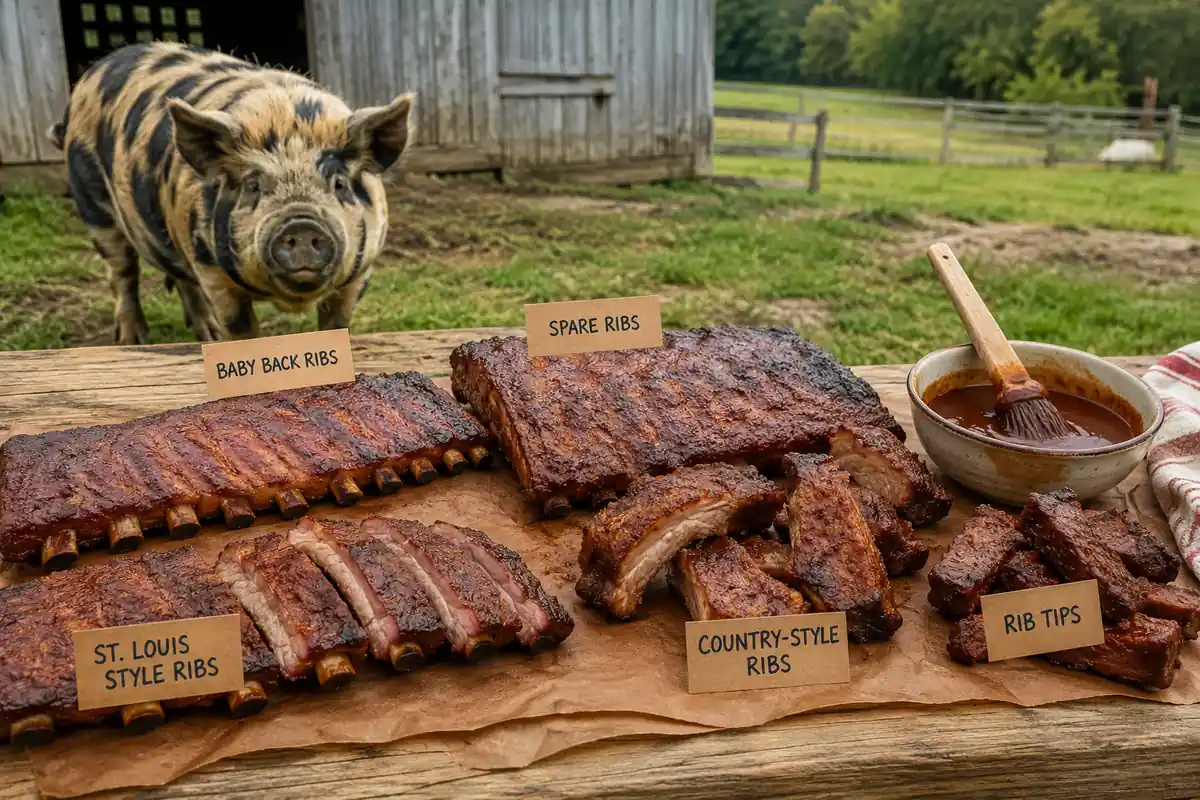
The Kunekune Rib Guide: Spare Ribs, Baby Backs, Country-Style Ribs, and How to Cook Each One
Pork ribs are one of those cuts that sound simple until you are looking at a freezer package, filling out a cut sheet, or standing over a smoker wondering whether you have baby backs, spare ribs, country-style ribs, or something in between. With Kunekune pork, ribs can be especially rewarding because the meat often carries rich flavor, useful fat, and the kind of deep pork character that fits slow homestead cooking. The trick is knowing what rib cut you have, how that cut behaves, and whether it needs quick heat, low-and-slow cooking, braising, smoking, or freezer planning before it ever reaches the pan.
Why Ribs Need Their Own Guide
“Ribs” is one word, but it can describe several different packages of pork. That is where many home cooks get tripped up.
A rack of baby back ribs does not cook exactly like spare ribs. Country-style ribs are not the same as a neat slab of barbecue ribs. Rib chops are not cooked like rib racks at all. Rib tips and riblets may look like scraps, but they can become some of the best beans, broth, and smoked snacks in the kitchen.
This matters even more when you are raising pork, buying from a local farm, or working through a whole or half hog. The processor has to make choices. If you want more chops, that may affect what happens to the ribs. If you want baby back ribs, that may affect how the loin is cut. If you want spare ribs trimmed St. Louis-style, you may also want the rib tips packaged separately so they do not disappear into trim.
A good rib guide helps you do three things:
- Understand what is in each freezer package.
- Choose the right cooking method for the cut.
- Give clearer instructions when you talk to a processor.
Kunekune pork deserves that kind of attention. These pigs are often raised by families and homesteads because they are manageable, useful, and well-suited to smaller farms. When a pig has been raised with care, the kitchen work should honor the animal by using each cut well.
The Big Difference: Rib Rack, Rib Chop, or Country-Style Rib?
Before getting into each cut, it helps to separate rib-related pork into three broad groups.
Rib racks
These are the classic ribs most people picture when they think of barbecue. Baby back ribs, spare ribs, and St. Louis-style ribs all fall into this group. They have multiple bones in a rack and usually do best with patient heat.
Rib chops and rib roasts
These come from the rib section of the loin. They may have rib bones attached, but they cook more like pork chops or roasts than barbecue ribs. These cuts need careful internal temperature control so they stay juicy.
Country-style ribs
Country-style ribs are usually meaty strips or chunks, often from the shoulder or blade-end area. They may be bone-in or boneless. They are not usually a rack of ribs, and they often behave more like small shoulder pieces.
That one distinction can save a lot of kitchen frustration. A rib rack needs time for connective tissue and fat to soften. A rib chop needs careful doneness. A country-style rib often needs braising, slow cooking, or a tenderizing method.
Baby Back Ribs
Baby back ribs come from the upper rib area near the loin. They are shorter, curved, and usually more tender than spare ribs. The name does not mean they came from a baby pig. It simply refers to the smaller size of the ribs compared with spare ribs.
What baby back ribs look like
Baby back ribs are usually curved, narrower, and more uniform than spare ribs. They often have meat between the bones and sometimes a nice cap of meat over the top, depending on how the loin was cut.
On Kunekune pigs, baby backs may be smaller than grocery-store racks from large commercial hogs. That is normal. A smaller rack does not mean a poor-quality rack. It often means the animal was a different size and type. Kunekune ribs may not be huge, but they can be full of rich pork flavor.
How baby backs cook
Baby back ribs are generally more tender than spare ribs and usually cook faster. They still need low, steady heat, but they do not always need the same long cooking window as full spare ribs.
Good cooking methods include:
- Low-and-slow smoking
- Covered oven roasting
- Indirect grilling
- Slow cooking followed by a broiler or grill finish
- Braising, then glazing
Baby backs are a good rib choice for families who want a familiar rib dinner without quite as much trimming or extra cartilage.
Best uses for baby back ribs
Baby backs are excellent for:
- Classic barbecue ribs
- Honey-mustard glazed ribs
- Dry-rub smoked ribs
- Applewood or cherrywood smoked ribs
- Oven-baked family ribs
- Rib platters with slaw, beans, and cornbread
Because they are smaller and a little neater, baby back ribs are also a good choice for guests or family meals where you want an easy-to-serve rib rack.
Spare Ribs
Spare ribs come from the lower rib area closer to the belly. They are usually larger, flatter, fattier, and more irregular than baby back ribs. They may include cartilage, rib tips, and extra meat depending on how they are trimmed.
What spare ribs look like
A full rack of spare ribs is wider and flatter than a baby back rack. It may look less tidy, but it has a lot going for it. Spare ribs usually carry more fat and connective tissue, which can mean deeper flavor when cooked properly.
With Kunekune pork, spare ribs can be outstanding because rich pork and slow cooking go together beautifully. The extra fat and connective tissue need time, but when they are handled well, they give the ribs a satisfying texture and old-fashioned pork flavor.
How spare ribs cook
Spare ribs are a patience cut. They need gentle heat and enough time for the meat to soften. If they are cooked too hot and fast, they can become tough on the outside while the inside still has not relaxed.
Good cooking methods include:
- Low-and-slow smoking
- Covered oven roasting
- Indirect grilling
- Cider or broth braising
- Dry-rub roasting
- Sauce-glazed finishing near the end
Spare ribs should not be treated like pork chops. They need time, not panic.
Best uses for spare ribs
Spare ribs are great for:
- Backyard barbecue
- Smoked rib dinners
- Sticky glazed ribs
- Dry-rub ribs
- Braised ribs with onions and cider
- Rib meat pulled for sandwiches
- Pork-and-bean meals
- Broth and bone use after the first meal
If your family loves rich, slow-cooked pork, spare ribs are one of the best packages in the freezer.
St. Louis-Style Ribs
St. Louis-style ribs are spare ribs trimmed into a cleaner, more rectangular rack. The rib tips and some cartilage are removed, giving the rack a tidy shape that cooks more evenly and looks nice on a platter.
Why choose St. Louis-style ribs?
This cut gives you much of the flavor of spare ribs with a neater shape. They fit well on smokers, slice evenly, and are easier to serve at cookouts.
For a family that likes barbecue but wants a cleaner rib presentation, St. Louis-style ribs are a strong choice.
What happens to the trimmed pieces?
This is important: the trimmed rib tips are not waste.
If you ask for St. Louis-style ribs, also ask whether the processor can package the rib tips separately. Rib tips are flavorful and useful. They can be smoked, braised, simmered in beans, added to greens, or used for broth.
A whole-hog kitchen does not throw flavor away just because it is not shaped like a pretty rack.
Best uses for St. Louis-style ribs
Use St. Louis-style ribs for:
- Smoked barbecue ribs
- Sauce-glazed rib platters
- Dry-rub ribs
- Cookouts
- Guest meals
- Freezer packages meant for easy portioning
They are a good choice when you want ribs that look polished but still have the rich character of spare ribs.
Country-Style Ribs
Country-style ribs can be confusing because they are often not true ribs in the rack-of-ribs sense. They are usually meaty pieces cut from the shoulder area or blade end near the loin. They may be bone-in or boneless, and they usually have much more meat than a rib rack.
What country-style ribs look like
Country-style ribs look like thick strips, chunks, or small meaty slabs. Some have bone. Some do not. They are usually not connected in a rack.
This is a very practical cut for family cooking because it gives you a lot of meat without requiring everyone to eat around rib bones.
How country-style ribs cook
Country-style ribs often do best with tenderizing methods. They can be grilled, but they usually need slower cooking or careful heat management. If you throw them over direct high heat and cook them like steaks, they can tighten up before they become tender.
Good methods include:
- Braising
- Slow cooking
- Covered oven roasting
- Smoking
- Pressure cooking followed by broiling
- Grill finishing after a tenderizing cook
Country-style ribs are one of the best cuts for sauce, gravy, beans, rice, potatoes, and hearty family meals.
Best uses for country-style ribs
Country-style ribs are excellent for:
- BBQ-style pork over mashed potatoes
- Slow cooker pork and onions
- Braised pork with apples or cider
- Pork and beans
- Green chile pork
- Tomato-braised pork
- Smoked pork chunks
- Freezer meal kits
If you are feeding a family and want useful meat more than a dramatic rib rack, country-style ribs are hard to beat.
Rib Chops
Rib chops come from the rib section of the loin. They may have a rib bone attached and can be beautiful cuts, but they are not cooked like a rack of ribs.
A rib chop is a chop. That means it is a quicker-cooking cut that can dry out if overcooked.
How rib chops cook
Rib chops do well with:
- Cast iron searing
- Grilling
- Reverse searing
- Pan roasting
- Simple herb butter
- Apple or mustard pan sauce
For pork steaks, roasts, and chops, FoodSafety.gov lists 145°F with a 3-minute rest as the safe minimum internal temperature. Ground pork and sausage are listed at 160°F, and leftovers at 165°F. Use a food thermometer rather than guessing by color.
Why this matters on a cut sheet
If you want more rib chops, that may change how your rib racks are handled. If you want baby back ribs, that may change how the loin is handled. These are connected decisions.
When ordering a half or whole hog, it is worth asking your processor how rib choices affect the loin, chops, roasts, and rib packages.
Rib Tips, Riblets, and Trimmings
Rib tips, riblets, and meaty trimmings are easy to overlook, but they are some of the most useful pieces in a homestead kitchen.
Rib tips
Rib tips come from the lower portion of spare ribs when the rack is trimmed. They may include cartilage, meat, fat, and small bones. They are not as tidy as rib racks, but they are loaded with flavor.
Use rib tips for:
- Smoked snacks
- Beans
- Greens
- Broth
- Braised pork
- Rice dishes
- Soup starter packs
Riblets
Riblets are smaller rib pieces, often cut across or separated into shorter sections. They cook faster than full racks and can be good for casual meals.
Use riblets for:
- Oven-roasted appetizer ribs
- Sticky glazed rib pieces
- Braised rib meals
- Smoked rib bites
- Pork-and-bean suppers
Meaty rib trimmings
Trimmings are not trash. They can season a whole pot of beans or greens. They can become broth. They can be browned and simmered into a sauce. They can be saved in small freezer packs for winter cooking.
This is where a homestead kitchen shines. Not every package needs to be fancy. Some of the plainest packages are the ones that make the best everyday meals.
Why Kunekune Ribs Like Slow Cooking
Kunekune pork can have excellent richness, but that richness still has to be cooked properly. Ribs contain meat, bone, fat, connective tissue, and sometimes cartilage. Those pieces need time to become tender and pleasant.
Low, steady heat helps the fat soften and the connective tissue relax. Fast, harsh heat can make the meat tighten before the cut has a chance to become tender.
That is why ribs are often cooked well beyond the minimum safe temperature. The goal is not only safety. The goal is tenderness.
For rib racks, doneness is usually judged by texture more than a single thermometer number. You are looking for meat that has softened around the bones, bends when lifted, and can be bitten cleanly without being tough or mushy.
Safe Versus Tender
There is an important difference between meat that is safe and meat that is tender.
Food safety guidance gives minimum internal temperatures. For whole-muscle pork cuts such as steaks, roasts, and chops, the safe minimum is 145°F with a 3-minute rest. But ribs are commonly cooked longer because the texture improves as connective tissue and fat soften.
That does not mean ribs should be cooked carelessly. It means the cook is aiming for both safe food and good texture.
Use clean handling, avoid cross-contamination, cook thoroughly, and store leftovers properly. Then use tenderness cues to decide when ribs are enjoyable to eat.
How to Tell When Ribs Are Tender
Ribs do not always give perfect thermometer readings because the meat is thin, the bones interfere, and fat pockets can vary. Use several clues together.
The bend test
Lift the rack with tongs from one end. If the rack bends easily and the surface begins to crack slightly, it is getting tender.
The toothpick test
Slide a toothpick, skewer, or thermometer probe between the bones. It should go in with little resistance.
Bone pullback
The meat may pull back slightly from the ends of the bones. This is a useful sign, but not the only one.
The bite test
Some people like ribs that fall off the bone. Others prefer ribs that hold together but bite cleanly. For family cooking, either can be right. The goal is tender, flavorful pork, not winning an argument on the internet.
Removing the Membrane
Many rib racks have a thin membrane on the bone side. Some cooks remove it every time. Others leave it if it is thin. Removing it can help seasoning reach the meat and can make the ribs easier to eat.
To remove it:
- Turn the rack bone-side up.
- Slide a butter knife under one corner of the membrane.
- Loosen enough to grab.
- Use a paper towel for grip.
- Pull slowly across the rack.
If it tears, pull it off in pieces. If it refuses to cooperate, score it with a knife and keep moving. Supper does not need a wrestling match.
Basic Smoked Kunekune Ribs
Smoking is one of the best ways to cook ribs because smoke, fat, and slow heat work together beautifully.
Best rib cuts for smoking
Good smoking choices include:
- Spare ribs
- St. Louis-style ribs
- Baby back ribs
- Rib tips
- Country-style ribs
Spare ribs and St. Louis-style ribs are especially good for rich barbecue flavor. Baby backs are a little neater and may cook faster. Country-style ribs are meatier and may need a slightly different approach.
Simple smoked rib method
- Thaw ribs fully in the refrigerator.
- Pat dry.
- Remove or score the membrane if desired.
- Season with salt and dry rub.
- Let the rub sit while the smoker heats.
- Smoke low and steady.
- Wrap only if needed to protect moisture or speed tenderness.
- Unwrap near the end if you want the surface to firm back up.
- Sauce during the final stage if using sauce.
- Rest before slicing.
Wood choices
Good smoke woods for Kunekune ribs include:
- Apple
- Cherry
- Pecan
- Maple
- Oak in moderation
- Hickory in moderation
Kunekune pork already has rich flavor, so the smoke should support the meat instead of covering it up. Too much heavy smoke can make ribs bitter.
Oven-Baked Ribs for a Real Home Kitchen
Not every homestead kitchen has a smoker, and not every rib dinner needs one. Oven ribs can be excellent.
An oven gives steady heat, good control, and a practical way to cook ribs during rain, winter, busy seasons, or family evenings when tending a smoker is not realistic.
Basic oven method
- Thaw ribs fully.
- Pat dry.
- Season with salt and dry rub.
- Place on a sheet pan or in a roasting pan.
- Cover tightly with foil for a softer, more protected cook.
- Roast low and slow until tender.
- Uncover near the end.
- Brush with sauce or glaze if desired.
- Broil briefly or raise the heat to set the glaze.
- Rest before cutting.
When oven ribs are the best choice
Oven ribs are good for:
- Beginner cooks
- Winter meals
- Rainy days
- Small kitchens
- Busy family suppers
- Sauce-glazed ribs
- Tender ribs without smoker management
Do not apologize for oven ribs. Homestead cooking is about feeding people well with the tools you have.
Braised Ribs
Braising uses moist heat to tenderize meat. It is one of the best methods for country-style ribs, rib tips, and spare ribs when you want a fork-tender meal instead of a barbecue-style slab.
Best cuts for braising
Use braising for:
- Country-style ribs
- Rib tips
- Spare ribs
- Riblets
- Meaty trimmings
- Tougher or irregular rib packages
Good braising liquids
Good options include:
- Apple cider
- Pork broth
- Chicken broth
- Water with a splash of vinegar
- Tomato sauce
- Bean cooking liquid
- Sauerkraut juice mixed with broth
Flavor ideas
Try these combinations:
- Apple cider, onion, mustard, and thyme
- Tomato, garlic, paprika, and bay leaf
- Sauerkraut, apple, onion, and caraway
- Broth, beans, garlic, and smoked paprika
- Green chile, cumin, oregano, and onion
- Mushroom, onion, and cream added near the end
Basic braising method
- Brown the ribs if you have time.
- Remove excess fat if the pan has too much.
- Add onions, garlic, or vegetables.
- Add enough liquid to come partway up the meat.
- Cover tightly.
- Cook gently until tender.
- Reduce the liquid into a sauce if desired.
- Serve over potatoes, rice, beans, noodles, or bread.
Braising is forgiving, practical, and deeply useful for freezer pork.
Grilled Ribs Without Drying Them Out
Ribs can be grilled, but they should not be cooked like burgers or thin pork chops. Direct high heat can burn the outside before the inside becomes tender.
Use two-zone heat
Set up a hot side and a cooler side. On a charcoal grill, pile coals to one side. On a gas grill, use one burner hotter and leave another area cooler.
Start ribs over indirect heat, or sear briefly and move them away from the flame. Keep the lid closed so the grill behaves more like an oven.
Sauce late
Most barbecue sauces contain sugar. Sugar burns. Brush sauce on near the end, not at the beginning.
Watch flare-ups
Kunekune pork can have generous fat. That fat is delicious, but it can drip and flare. Keep a cooler zone ready so you can move the ribs if needed.
Best rib cuts for grilling
Good grilling choices include:
- Baby back ribs
- St. Louis-style ribs
- Spare ribs over indirect heat
- Country-style ribs after a slower start
The key is patience. Grill flavor is wonderful, but tenderness still takes time.
Dry Rubs for Kunekune Ribs
A dry rub should make the pork better, not hide it. Kunekune pork has enough flavor that you do not need to bury it under every spice in the cabinet.
Simple all-purpose rib rub
Use:
- Salt
- Black pepper
- Paprika
- Garlic powder
- Onion powder
- A little brown sugar
- Optional mustard powder
- Optional chili powder
Pepper-forward barbecue rub
Use:
- Salt
- Coarse black pepper
- Paprika
- Garlic
- Onion
- A little cayenne
- Optional brown sugar
This is good for spare ribs and St. Louis-style ribs.
Herb-style rib rub
Use:
- Salt
- Pepper
- Garlic
- Thyme
- Sage
- Rosemary
- A small amount of paprika
This works nicely for oven ribs, country-style ribs, or ribs served with potatoes and greens.
A note about salt
If your rub already contains salt, do not salt separately unless you have accounted for it. Ribs have a lot of surface area, and it is easy to overdo salted rubs.
Sauce, Glaze, or Dry?
There is no single right answer. The best choice depends on the meal.
Dry ribs
Dry ribs rely on pork flavor, salt, spices, smoke, and good cooking. This is a good choice when the meat itself is excellent and you want people to taste it clearly.
Sauced ribs
Sauced ribs are familiar, sticky, and family-friendly. They are great for cookouts, casual meals, and plates with slaw and beans.
Glazed ribs
A glaze is usually thinner than a heavy sauce and is added near the end. Good glaze ideas include:
- Apple cider reduction
- Maple mustard
- Honey mustard
- Pepper jelly
- Sorghum and vinegar
- Brown sugar and cider vinegar
Sauce on the side
For good Kunekune pork, consider serving sauce on the side. That lets the pork stand on its own and lets each person choose how much sauce they want.
What to Ask the Processor
This section may be the most useful part of the whole guide for families filling a freezer.
Processor instructions affect what you get back. The rib section connects to the loin, belly, shoulder, and trim. That means rib choices can affect other packages.
Questions to ask
Ask your processor:
- Do you offer baby back ribs?
- Do you offer spare ribs?
- Can you trim spare ribs St. Louis-style?
- Can rib tips be packaged separately?
- Can I get country-style ribs?
- Are country-style ribs bone-in or boneless?
- How many ribs usually go in a package?
- Can rib racks be cut in half for smaller meals?
- Can ribs be vacuum-sealed?
- How will choosing ribs affect my pork chops or loin roasts?
- Can rib trimmings be saved for broth or sausage trim?
Think about how your family actually eats
If you love barbecue, ask for rib racks. If you want easy weeknight meals, country-style ribs may be more useful. If you cook for two people, ask for smaller packages. If you host family dinners, larger racks may be fine.
A good cut sheet is not about getting the fanciest words. It is about getting pork your household will actually cook.
Freezer Planning for Ribs
Ribs can be awkward in the freezer because racks are long, bony, and uneven. Good packaging and labeling matter.
FoodSafety.gov lists fresh pork chops and roasts at 3 to 5 days in the refrigerator and 4 to 12 months in the freezer for quality. Cooked meat leftovers are listed at 3 to 4 days in the refrigerator and 2 to 6 months in the freezer for quality; frozen foods kept continuously at 0°F or below can be kept indefinitely from a safety standpoint, but freezer chart times are quality recommendations.
Better package labels
Ask for clear labels such as:
- Baby back ribs
- Spare ribs
- St. Louis-style ribs
- Rib tips
- Riblets
- Country-style ribs
- Rib chops
- Rib trimmings for broth
A package labeled only “pork” is how good meat gets lost in the freezer.
Package sizes
Think in real meals:
- Half racks for smaller households
- Full racks for cookouts
- One-pound rib tip packs
- Two-pound country-style rib packs
- Small broth packs with bones and trim
- Family-size packs for Sunday cooking
Freeze with a plan
When ribs go into the freezer, imagine how they will come out. Will they be smoked? Braised? Used for beans? Saved for a holiday? That little bit of planning prevents waste.
Thawing Ribs Safely
The best way to thaw ribs is in the refrigerator. Large racks can take a day or more, so plan ahead.
If you need a faster thaw, use cold water with the pork sealed in a leakproof package. Change the water regularly and cook promptly after thawing.
Avoid thawing ribs on the counter for hours. The outside can warm while the inside is still frozen, and that is not a good food-safety habit.
Side Dishes That Work with Kunekune Ribs
Ribs are rich, so good sides bring brightness, starch, crunch, or acidity.
Good rib sides include:
- Vinegar slaw
- Apple slaw
- Baked beans
- White beans
- Cornbread
- Potato salad
- Roasted sweet potatoes
- Collard greens
- Green beans
- Cucumber salad
- Pickled onions
- Garden tomatoes
- Sauerkraut
- Macaroni and cheese
- Beans and rice
For summer, go bright and crisp. For winter, go hearty with beans, greens, potatoes, and broth.
Leftover Rib Ideas
Leftover ribs are useful if you handle them gently. Do not keep blasting them with high heat until the meat dries out.
Pull leftover meat from the bones and use it in:
- Breakfast hash
- Beans
- Fried rice
- Tacos
- Quesadillas
- Baked potatoes
- Soup
- Ramen-style noodle bowls
- BBQ sandwiches
- Cornbread casseroles
- Greens with pork
- Pork gravy over biscuits
Reheat leftovers to 165°F, and store cooked meat leftovers within the refrigerator and freezer timeframes listed by FoodSafety.gov.
Making Pork Broth from Rib Bones
Rib bones can make wonderful broth, especially when there is still a little meat, fat, and connective tissue attached.
Simple rib bone broth
- Place rib bones in a pot.
- Add onion, celery, garlic, bay leaf, and peppercorns.
- Cover with cold water.
- Simmer gently.
- Skim if needed.
- Strain.
- Chill.
- Skim fat if desired.
- Use or freeze.
Do not boil hard for hours. A gentle simmer gives a cleaner flavor.
Use pork broth for:
- Beans
- Greens
- Rice
- Soup
- Noodles
- Gravy
- Stew
- Braised cabbage
- Potatoes
A good broth turns rib bones into another meal. That is exactly the kind of kitchen economy homesteads need.
A Practical Rib Meal Plan
Here is one way to stretch a rib package into more than one meal.
Meal 1: Rib dinner
Cook baby backs, spare ribs, or St. Louis-style ribs with a dry rub. Serve with slaw, beans, and cornbread.
Meal 2: Leftover pork
Pull leftover rib meat and use it for tacos, fried rice, baked potatoes, or breakfast hash.
Meal 3: Broth
Use the bones for pork broth. Freeze the broth in two-cup portions.
Meal 4: Beans or greens
Use the broth later for beans, greens, soup, or rice.
That is a freezer working properly. One package becomes several useful meals.
Common Rib Mistakes
Cooking too hot
Ribs need time. Too much heat too soon can make them tough.
Saucing too early
Sugar burns. Sauce near the end.
Not allowing enough time
Ribs are not a last-minute cut. Even simple oven ribs need a patient window.
Treating country-style ribs like rack ribs
Country-style ribs are meaty and often shoulder-like. Braising or slow cooking may be better than rack-style cooking.
Forgetting the trimmings
Rib tips, bones, and trimmings are flavor. Save them, label them, and use them.
Over-smoking
A little smoke is beautiful. Too much smoke can turn bitter and cover the pork.
Poor freezer labels
Mystery meat gets ignored. Clear labels make the freezer easier to use.
Kunekune Ribs and Whole-Hog Respect
Ribs are a good reminder that pork is not only bacon and chops. A pig gives many kinds of food: quick cuts, slow cuts, bones, fat, trim, roasts, broth pieces, and meaty odds and ends.
Respectful meat use means learning what each package wants to become. Spare ribs may want smoke. Country-style ribs may want braising. Rib tips may want beans. Bones may want broth. None of that is second-best cooking. It is how a whole-hog kitchen becomes practical and abundant.
BF Farm Kunekune Pigs focuses on quality Kunekune breeder stock for families and homesteads that care about temperament, structure, manageability, and long-term usefulness. Those choices matter in the pasture, and they carry into the kitchen. Good livestock decisions and good cooking habits belong together.
Quick Rib Cut Cheat Sheet
Baby back ribs
Best for: classic rib slabs, oven ribs, smoking, family meals
Cooking style: low and steady
Texture: tender, smaller, neater
Good for beginners: yes
Spare ribs
Best for: barbecue, smoking, rich pork flavor
Cooking style: low and slow
Texture: meaty, fatty, flavorful
Good for beginners: yes, with patience
St. Louis-style ribs
Best for: tidy barbecue racks, guests, smoker meals
Cooking style: low and slow
Texture: spare rib flavor in a cleaner shape
Good for beginners: yes
Country-style ribs
Best for: braising, slow cooker meals, fork-and-knife suppers
Cooking style: braise, slow cook, smoke, or covered roast
Texture: meaty and hearty
Good for beginners: very practical
Rib tips
Best for: beans, snacks, broth, smoking, braising
Cooking style: smoke, simmer, or braise
Texture: flavorful, bony, cartilage-rich
Good for beginners: yes, in forgiving dishes
Rib chops
Best for: skillet, grill, quick meals
Cooking style: cook like pork chops, not rib racks
Texture: chop-like and quicker cooking
Good for beginners: yes, with a thermometer
Final Thoughts
Kunekune ribs are worth understanding because they can become so many good meals. Baby backs give you a neat rack. Spare ribs bring rich barbecue flavor. St. Louis-style ribs offer tidy presentation. Country-style ribs are meaty and practical. Rib tips, riblets, bones, and trimmings can season beans, make broth, and stretch the value of the whole animal.
The main lesson is simple: know the cut before you choose the method. Ribs need patience, thoughtful heat, and respect for fat, bone, and connective tissue. When you give them that, they reward you with deep pork flavor and meals that feel rooted in real homestead cooking.
A freezer full of pork is more useful when every package has a plan. Once you understand the rib section, the packages marked “ribs” stop being confusing and start looking like supper.